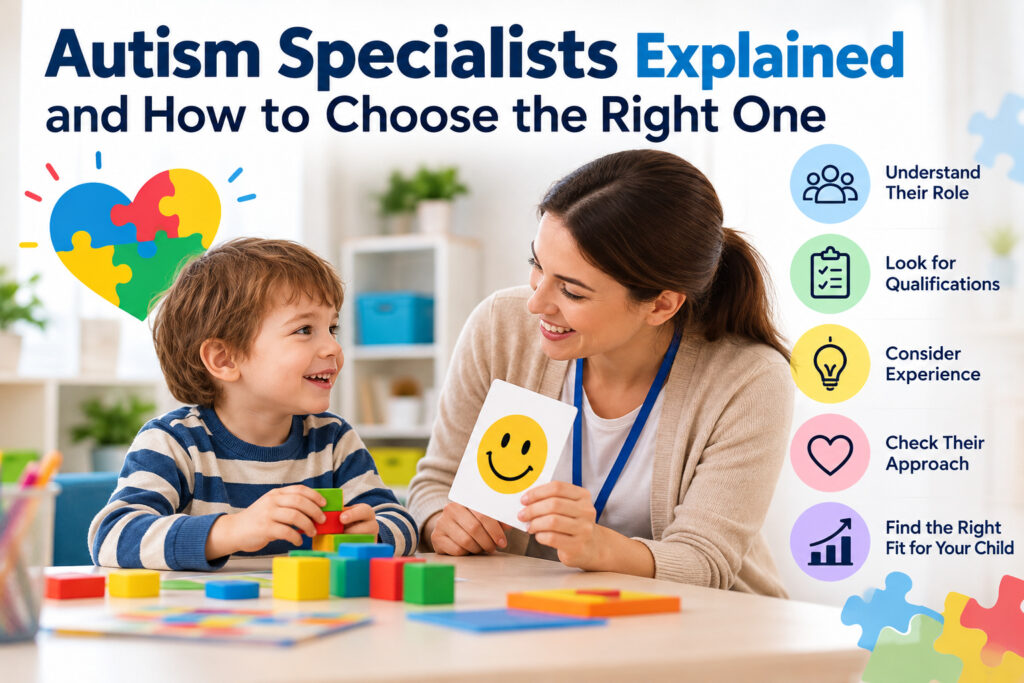
autism-specialists-peachtree-city-ga
Autism specialists include pediatricians, psychologists, BCBAs and therapists. Learn who does what, how to choose one, and what to ask before you start.
TL;DR Autism specialists are licensed professionals who evaluate, diagnose, or support autistic people, and no single specialist does everything. Developmental pediatricians, child psychologists, psychiatrists, and neurologists usually diagnose. Speech-language pathologists, occupational therapists, and Board Certified Behavior Analysts (BCBAs) usually treat and teach. Most families end up with a small team, and the order matters: screening first, then a diagnostic evaluation, then a written treatment plan. The CDC reports that about 1 in 31 eight-year-olds in the United States has an autism diagnosis, so demand for these services is high. Look for credentials you can verify, experience with your child’s age group, a plan that includes parents, and willingness to coordinate with other providers. Ask how progress is measured, which insurance plans are accepted, and how long the wait is. Early support tends to work best, but starting later still helps.
Your pediatrician mentions a developmental concern, or a teacher suggests an evaluation, and suddenly you are searching for autism specialists without knowing who to call first. The titles blur together. Waitlists stretch for months. Every provider seems to promise something different, and that confusion can delay support when it matters most. This guide explains what each type of autism specialist does, how an evaluation for autism spectrum disorder works, and how to pick a provider you trust. You will also learn what to ask, what to avoid, and where to look for autism specialists near you.
Quick Answer An autism specialist is a licensed professional trained to evaluate, diagnose, or support people with autism. Developmental pediatricians and psychologists diagnose. Speech therapists, occupational therapists, and Board Certified Behavior Analysts provide treatment. Start with your pediatrician, get a diagnostic evaluation, then build a team whose credentials you can verify and whose approach fits your child.
What Are Autism Specialists?
Autism specialists are licensed healthcare, education, or behavioral professionals with focused training in autism spectrum disorder. They screen for autism, complete diagnostic evaluations, or deliver therapies that build communication, social, behavioral, and daily living skills. The title itself is not a protected credential, so the specific license, such as MD, PsyD, CCC-SLP, or BCBA, tells you more than the word specialist does.
Types of Autism Specialists and What Each One Does
Autism care draws on several fields. Some professionals diagnose. Others teach skills, treat related health conditions, or guide school planning. Knowing the difference saves time and prevents repeat evaluations.
| Specialist | Main role | Credential to look for |
|---|---|---|
| Developmental pediatrician | Diagnoses autism and manages medical needs | Medical license, board certification |
| Child psychologist | Runs diagnostic testing and developmental review | State license (PhD or PsyD) |
| Child psychiatrist | Treats co-occurring conditions and medication | Medical license, psychiatry training |
| Pediatric neurologist | Checks seizures, sleep, and neurological issues | Medical license, neurology training |
| Speech-language pathologist | Builds communication and social language | CCC-SLP and state license |
| Occupational therapist | Supports daily living, sensory, and motor skills | State occupational therapy license |
| Board Certified Behavior Analyst | Designs and supervises ABA treatment programs | BCBA certification from the BACB |
| Registered Behavior Technician | Delivers therapy under BCBA supervision | RBT credential from the BACB |
Diagnostic autism specialists
Developmental pediatricians, child psychologists, child psychiatrists, and pediatric neurologists most often complete the developmental evaluation. Many use the DSM-5-TR criteria together with standardized tools such as the ADOS-2, parent interviews, and direct observation of play and communication. The result is a diagnostic assessment that schools, insurers, and therapy providers can act on.
Treatment and therapy specialists
Speech-language pathologists work on spoken language, gestures, and alternative communication. Occupational therapists address feeding, dressing, handwriting, and sensory needs. A behavior analyst holds a graduate degree and certification from the Behavior Analyst Certification Board (BACB). BCBAs assess skills, write the treatment plan, and train both therapists and parents. Registered Behavior Technicians deliver sessions under that supervision.
Medical and school-based support
Your child’s pediatrician remains the hub for general health, referrals, and screening. Neurologists and psychiatrists step in when seizures, sleep problems, anxiety, or attention concerns appear alongside autism. At school, an evaluation team determines eligibility for services under the Individuals with Disabilities Education Act (IDEA) and helps write the Individualized Education Program (IEP).
Key point: Autism specialist is a general label. Ask for the exact license or certification, because that tells you what the person is trained and allowed to do.
How an Autism Evaluation Works
A developmental evaluation follows a predictable path. Understanding it helps you prepare and avoid gaps.
Step 1: Developmental screening
The American Academy of Pediatrics recommends autism-specific screening at 18 and 24 months, usually with a parent questionnaire such as the M-CHAT-R/F. Screening flags risk. It does not diagnose. A positive screen is a reason to move to a full evaluation, not a conclusion.
Step 2: Diagnostic evaluation
A qualified clinician reviews developmental history, observes the child, and uses standardized tools to compare communication, social interaction, and behavior patterns against diagnostic criteria. Sessions may span several visits. Expect questions about early milestones, sensory reactions, routines, and strengths.
Step 3: Written report and treatment plan
The clinician explains findings, gives a written report, and recommends services. A strong report names specific goals, such as building functional communication, improving sleep, or supporting classroom participation. Bring it to your pediatrician, school team, and any therapy provider you consider.
Children under three can often receive help before a formal diagnosis. Under IDEA Part C, each state runs an early intervention program for infants and toddlers with developmental delays. In Georgia, that program is called Babies Can’t Wait. Early intervention services can begin while you wait for a diagnostic appointment.
Key point: Screening, diagnosis, and treatment are three separate steps. Do not wait for a perfect diagnosis to ask about early intervention.
Which Autism Specialist Should You See First?
The right first call depends on where you are in the process. Many parents ask about an autism specialist versus a developmental pediatrician. The pediatrician is one kind of autism specialist, and the broader term also covers therapists and behavior analysts.
| Situation | Start with | Why |
|---|---|---|
| Concern at a routine checkup | Your child’s pediatrician | Screens and refers |
| You need a formal diagnosis | Developmental pediatrician or psychologist | Can diagnose and document |
| Diagnosis done, skills needed | BCBA, speech therapist, or OT | They teach and treat |
| Seizures, sleep, or anxiety | Neurologist or psychiatrist | They treat medical conditions |
| Support needed at school | School evaluation team | Builds an IEP under IDEA |
If you are unsure, call your pediatrician first. Ask for a referral and ask whether your insurance plan requires one.
How to Choose the Right Autism Specialist
Two providers with the same title can work very differently. Use the following checks before you commit.
Verify credentials
Check state licensing boards for psychologists, physicians, speech-language pathologists, and occupational therapists. To verify a BCBA, search the BACB certificant registry, which is public. A provider who hesitates to share credentials is a signal to look elsewhere.
Ask about approach and philosophy
Good autism specialists explain their methods in plain language. Useful questions include:
- How do you set goals, and how do parents shape them?
- How do you measure progress, and how often will we review it?
- How do you respect my child’s comfort, preferences, and ability to say no?
- Do you train parents and coordinate with the school and other therapists?
- What does a typical session look like?
Modern ABA programs increasingly pair skill teaching with child choice and emotional well-being, and some providers integrate Acceptance and Commitment Therapy (ACT). Ask each provider to describe how they do it.
Confirm logistics
Ask which insurance plans they accept, how long the wait is for an intake, and what setting they offer. Wait times differ by region and by specialty, so ask for a realistic estimate and whether a cancellation list exists.
Red flags to avoid
- Promises of a cure or guaranteed results
- No written treatment plan or no parent involvement
- Pressure to sign up before you understand costs
- Dismissing your child’s distress as noncompliance
Key point: The best provider is not the one with the longest title. It is the one with verifiable credentials, a clear plan, and respect for your child and family.
Therapy Settings and Local Options
Settings shape how skills carry over into daily life. Each has trade-offs.
| Setting | Strengths | Trade-offs |
|---|---|---|
| Home | Real routines, family involved | Fewer chances for peer practice |
| Center | Peer practice, structured space | Travel required |
| Virtual | Reaches families far from a clinic | Needs strong parent participation |
| School | Supports classroom skills | Depends on school cooperation |
| Community | Practices skills in real places | Less predictable environment |
Local access matters. In Georgia, for example, Regency ABA in Peachtree City offers ABA therapy at home, in a center, through telehealth, in the community, and in school, along with autism screening and early intervention services. Families elsewhere can search a state’s licensing board, a pediatrician’s referral list, or an insurer’s provider directory to find autism specialists near them. Insurance rules differ by state and plan, so call your insurer and ask whether an autism evaluation and ABA therapy are covered.
Building a Team That Works Together
Autism affects communication, learning, sensory processing, and behavior, so progress usually comes from coordinated care. Share evaluations across providers, hold a joint review once or twice a year, and keep a single folder with reports, goals, and IEP documents. Your own observations count. You know which goals matter at home.
What Parents and Professionals Say About Finding Autism Specialists
Online communities such as Reddit and Quora, along with professional discussions, repeat the same themes. The summary below reflects common consensus, not any single post.
What most people misunderstand
Many families assume one specialist handles everything. In practice, the diagnostician and the therapist are often different people. Another common belief is that a diagnosis must come before any help. Early intervention and school evaluations can start without a medical diagnosis. People also assume a long waitlist means a better provider, when it often reflects demand or limited staffing.
Common mistakes
Parents often accept the first available appointment without checking credentials. Others skip the written report, which makes later referrals harder. Some choose a setting based on convenience alone and never revisit it. A frequent regret is waiting months for a perfect provider while a good enough option could have started support sooner.
What experienced users and professionals recommend
Experienced parents advise joining the waitlist at several providers at once and asking for cancellation calls. Professionals recommend asking for a trial session or intake meeting, checking that goals reflect family priorities, and reviewing progress at scheduled intervals. They also suggest connecting with local autism organizations, since families there often know which providers communicate well.
What is the best doctor to diagnose autism? A developmental pediatrician or a licensed child psychologist is the most common choice. Child psychiatrists and pediatric neurologists also diagnose in many practices. Choose someone with experience evaluating children at your child’s age.
At what age should you see an autism specialist? See one as soon as you have a concern, at any age. The American Academy of Pediatrics recommends autism screening at 18 and 24 months, and parents do not have to wait for those visits to raise questions.
What is the difference between an autism specialist and a BCBA? An autism specialist is a general term for any professional focused on autism. A BCBA is one specific certified role, focused on behavior analysis, treatment planning, and supervising therapy. BCBAs usually do not diagnose.
What happens at a first visit with an autism specialist? Expect a conversation about development, health, and family history, plus observation of your child. You may complete questionnaires beforehand. Bring prior reports, school records, and a list of concerns.
How do I find an autism specialist near me? Ask your pediatrician for referrals, check your insurer’s provider directory, and search state licensing and BACB registries. Confirm each provider’s credentials, wait times, and accepted plans before booking.
How much do autism specialists cost, and does insurance cover them?
Costs vary by specialty, region, and plan. Diagnostic evaluations and therapy are billed differently, so ask each provider for a clear estimate. Many commercial and public plans cover autism evaluations and ABA therapy, but coverage rules, age limits, and authorization steps differ by state and insurer. Call your insurance company before the first visit and ask whether a referral, prior authorization, or in-network provider is required. Ask the specialist’s office whether they verify benefits for you. If cost is a barrier, also ask about early intervention programs, school-based services, and state Medicaid options, which may reduce what you pay out of pocket.
How long is the wait for an autism evaluation?
Waits depend on location and specialty, and they can stretch into months in many areas. You can shorten the process by calling several providers, asking to be placed on cancellation lists, and requesting a referral from your pediatrician, who may know which clinics move faster. While you wait, ask about early intervention for children under three and a school evaluation for older children, since neither requires a formal diagnosis. Keep notes about your child’s behavior, strengths, and daily routines. Clear observations help the clinician work efficiently once the appointment arrives.
Do I need a referral to see an autism specialist?
It depends on your insurance plan and the type of specialist. Many health plans require a pediatrician referral for developmental pediatricians, neurologists, and psychiatrists. Psychologists and therapy providers may accept self-referral, although insurers often still want a diagnosis and written order before they approve services. Call both the specialist’s office and your insurer to confirm. Ask what documents you must bring, such as screening results, school records, or prior therapy notes. A short call up front can prevent a rejected claim or a canceled appointment later.
Can adults see autism specialists too?
Yes. Many adults seek an autism evaluation after years of feeling different or after a child receives a diagnosis. Licensed psychologists and psychiatrists with adult autism experience can complete a diagnostic assessment. Fewer clinics offer adult evaluations, so the wait can be longer. Ask whether the clinician has experience with adult presentations, since traits can look different from childhood patterns. A diagnosis can open the door to workplace accommodations, counseling, and a clearer understanding of strengths and support needs.
Choosing among autism specialists feels heavy because the stakes feel high, but the process is manageable once you know the roles. Start with screening and a trusted pediatrician. Get a diagnostic evaluation from a qualified clinician. Then build a team of therapists and school partners whose credentials you can verify and whose goals match your family’s priorities. Expect to adjust the plan as your child grows. Keep your written reports organized, ask direct questions, and trust your observations. Progress rarely follows a straight line, but the right support makes each step clearer.
Key Takeaways
- Autism specialists are a group of licensed professionals, not one job title.
- Developmental pediatricians and psychologists diagnose. Therapists and BCBAs treat and teach.
- Screening, diagnosis, and treatment are separate steps, and early intervention can begin before a diagnosis.
- Verify credentials through state boards and the BACB registry.
- Ask about goals, parent training, progress reviews, and respect for your child’s comfort.
- Compare home, center, virtual, school, and community settings based on your child’s needs.
- Confirm insurance, referrals, and wait times early, and join several waitlists.